
 PW Exclusive, in your pocket. News, predictions & the forum — now as an app.


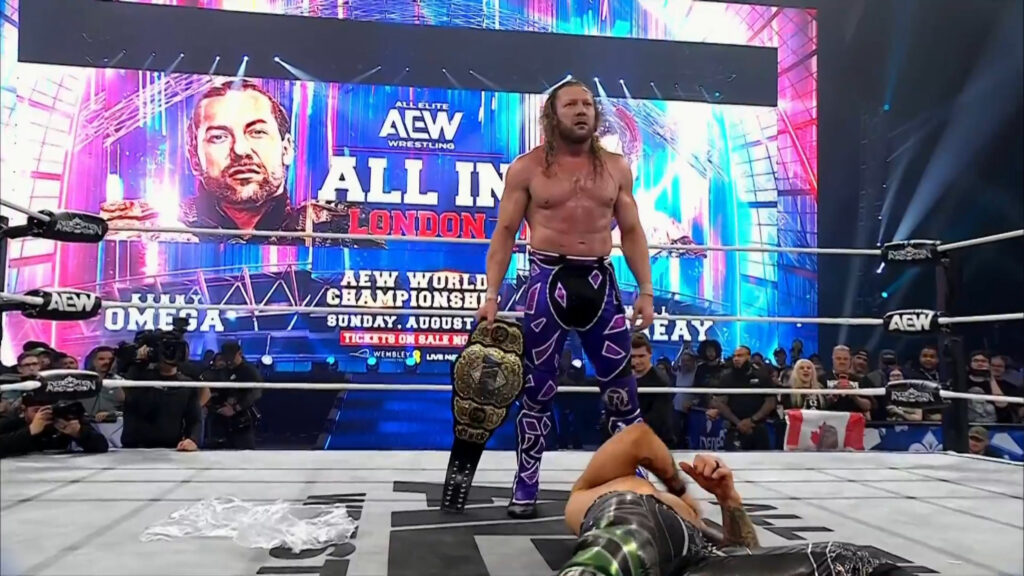
Will Ospreay promising the Tiger Driver ’91 for his AEW World Title match with Kenny Omega is the loudest storytelling signal AEW has sent in months — and it’s aimed straight at the hardcore fanbase.
Every so often a wrestler says something that lands differently depending on how deep you are into the sport. To a casual fan, Will Ospreay vowing to use the Tiger Driver ’91 on Kenny Omega at All In for the AEW World Championship reads like standard pre-match trash talk — another big move promised before a big fight. To anyone who’s followed Ospreay’s arc, or the lineage of the move he’s threatening, it’s something else entirely. It’s a statement of intent. It’s a man announcing he’s willing to go somewhere dark to get what he wants.
Let me explain why this one line carries more weight than almost anything else AEW is doing right now.
For the uninitiated: the Tiger Driver ’91 is one of the most dangerous-looking moves in wrestling history. It’s a variation of the standard Tiger Driver where the recipient is dropped on the back of the head and neck rather than landing more safely on the upper back. It was made infamous by Mitsuharu Misawa in All Japan Pro Wrestling during the legendary King’s Road era — the style built on escalating, punishing head-drops that told a story of two men destroying each other for pride.
In modern wrestling, the move is almost never done casually. It’s reserved for finishes, for the biggest matches, for moments where the story demands that a wrestler abandon caution. When someone promises to break it out ahead of time, they’re not bragging about their offense — they’re telling you they’ve decided the normal rules don’t apply anymore.
That’s the entire point. Ospreay isn’t saying “I’m going to beat Kenny Omega.” He’s saying “I’m going to hurt Kenny Omega in a way I’ve held back from before.” For a performer whose in-ring vocabulary is already terrifyingly deep, choosing this specific move as the escalation is a deliberate, loaded choice.
Here’s where the history clicks into place. Kenny Omega is arguably the most prominent Western torchbearer of exactly the style that birthed the Tiger Driver ’91. His career-defining run in New Japan — the trilogy of matches that redefined what a Western wrestler could be in Japan — was steeped in the King’s Road tradition of head-drops, endurance, and dramatic escalation. Omega has taken and given some of the most brutal-looking sequences in the sport’s modern era.
So when Ospreay points to the Tiger Driver ’91 specifically, he’s essentially speaking Omega’s own language back to him. He’s saying: I know exactly what pantheon you come from, and I’m going to use the most feared weapon from that pantheon against you. It’s not just a threat — it’s a challenge to Omega’s identity as the guy who supposedly conquered that world.
Both men also carry the burden of their bodies. Omega’s history of injuries and grueling matches is well documented, and Ospreay himself has spoken openly about the physical toll of his style. That subtext — two performers who know the cost of what they do, threatening to push each other past the line anyway — is what elevates this from spectacle to genuine drama.
This didn’t come out of nowhere. Ospreay has spent his AEW run positioning himself as a wrestler defined by both dazzling athleticism and a mischievous, human edge — the same duality he’s leaned into when he talks about how UK crowds understand his cheeky persona. That likeable, playful side is exactly what makes a promise like this hit harder. When the funny, charming guy tells you he’s ready to drop someone on their head, it registers as a man who’s been pushed to abandon the fun.
That’s smart character work, whether it’s coming from Ospreay himself or the booking around him. AEW has, at various points, been accused of loading its cards with big matches that lack narrative connective tissue — a criticism that even hangs over stacked shows like the six-title-fight Redemption card, where the sheer volume can flatten the stakes. A World Title match built on a single, specific, deeply meaningful threat is the antidote to that. It gives fans something concrete to anticipate and dread.
Here’s my read, framed clearly as analysis and not any kind of insider claim: the promise of the Tiger Driver ’91 only works if AEW pays it off in one of two ways.
The worst outcome — and the one I’d bet against, because both men are far too smart for it — is that the move gets thrown out mid-match as just another spot, robbing the pre-match promise of all its weight. Chekhov’s Tiger Driver has to go off with meaning.
What makes this compelling is that Ospreay put the words out there publicly. He’s created an expectation. Now the match has to honor it, and that self-imposed pressure is exactly the kind of stakes wrestling storytelling should chase more often. A finisher promised in advance is a promise the audience will hold you to.
Do you think Ospreay actually pulls the trigger on the Tiger Driver ’91 — and should Omega kick out if he does? Drop your predictions in the comments and let’s argue it out.
Reporting and match coverage produced by the PW Exclusive team. Articles under this byline are drafted with AI assistance and reviewed before publication — see our editorial standards for how we work.
More from PW Exclusive Staff →
Get all the latest ahead of AEW's return to Wembley Stadium
Visit the Hub
Join the discussion. Free MyPWE account — comment, react and get replies.
Create free account Log in