
 PW Exclusive, in your pocket. News, predictions & the forum — now as an app.


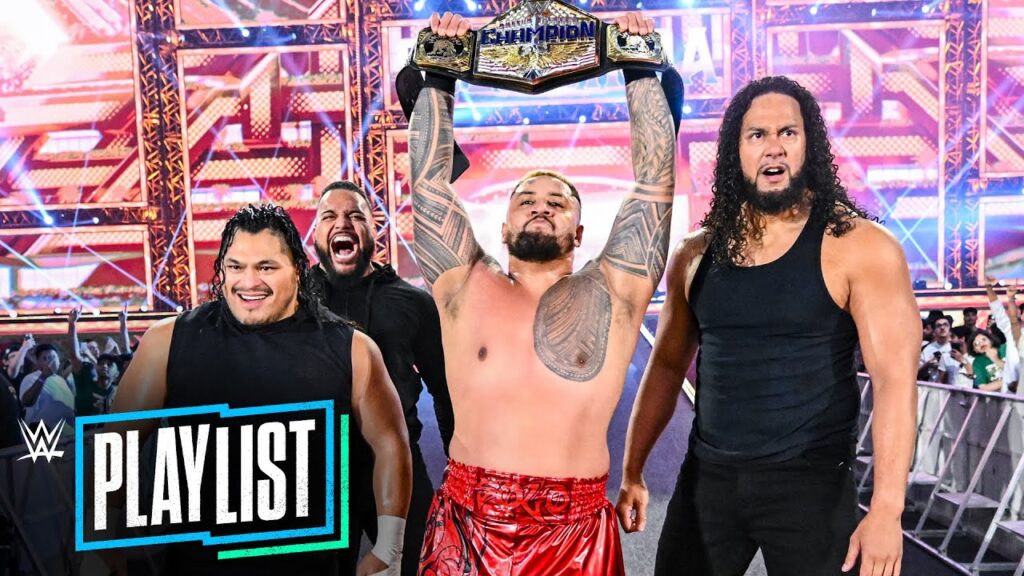
When a guy with Jeff Cobb’s talent tells you the group looked better on paper than in the ring, that’s not sour grapes — it’s a diagnosis.
Jeff Cobb — who worked WWE television as JC Mateo inside the reworked Bloodline offshoot known as the MFTs — has gone on record saying the faction didn’t play out the way it was pitched to him. The idea, in his telling, looked promising on paper. The execution didn’t match the sales pitch. And if you’ve watched WWE build (and abandon) groups over the last decade, that sentence should feel painfully familiar.
This isn’t a wrestler whining about his spot. Cobb is one of the most physically gifted big men on the planet, a former Olympic-level athlete who spent years as one of the most respected imports on the independent and Japanese scenes. When someone with that resume tells you a concept fizzled, the honest response isn’t to shrug — it’s to ask why WWE keeps running the same play and getting the same result.
Let’s ground this. The original Bloodline was the best long-form storytelling WWE had produced in a generation — a slow-burn family saga that turned Roman Reigns into the defining act of the era and made stars out of everyone it touched. When a story is that good, the temptation to spin off, remix, and franchise it is enormous. Hence the MFTs: a new-look version built to extend the mythology without leaning entirely on the original cast.
Cobb was brought in as part of that expansion. And per his own account, the group was pitched with a vision that never fully materialized on screen. That’s the crux. The concept had juice. The follow-through didn’t. A faction is only as strong as the reasons its members are standing next to each other, and “we’re a unit because the story needs a unit” is not a reason an audience can feel.
Here’s the uncomfortable truth for a company printing money — and TKO is absolutely printing money, having just posted $1.547 billion in Q2 2026 revenue. Financial health and creative discipline are two entirely different things. You can sell out buildings and still fumble the actual wrestling stories, and factions are where that fumble shows up most often.
The pattern goes like this:
The original Bloodline avoided all of this because it had a beating heart: family, betrayal, insecurity, power. Every member had a clear emotional relationship to Reigns. You could draw the org chart on a napkin. The MFTs, by Cobb’s account, never got that clarity — and without it, a faction is just a group of talented people sharing entrance music.
What makes this specific case sting is the raw material involved. Cobb isn’t a role player you plug in to eat pins. He’s a legitimate difference-maker — the kind of athlete other companies build entire divisions around. If WWE couldn’t figure out how to make him matter inside a faction that was custom-built as a spotlight machine, the issue isn’t the talent. It’s the plan.
And it’s part of a wider theme WWE fans keep circling back to right now. The most compelling stuff on the roster isn’t always tied to gold or to grand designs — it’s the moments where hungry talent gets a clear runway. Compare Cobb’s frustration to a guy like Je’Von Evans, who says the only thing stopping him is himself. Evans has clarity of purpose. He knows exactly what his character wants and why. The MFTs, by contrast, sound like they had a great logo and a fuzzy mission statement.
That’s the lesson buried in Cobb’s honesty: talent is cheap when your storytelling framework is broken. WWE has more good wrestlers than it can possibly feature. What it doesn’t have — at least not consistently — is the discipline to give a group a spine and stick with it through the inevitable booking pressures.
My read? The MFTs as a concept are effectively cooked, and that’s fine — not every experiment needs to succeed. The healthier outcome is that WWE extracts the individual pieces and gives them defined roles rather than trying to prop up a group that never found its footing. For Cobb specifically, the best possible future is a run where his athleticism is the story, not a subplot inside someone else’s arc.
The broader worry is whether WWE learns anything. This is a company self-aware enough that its own president reportedly wants media partners to stay critical of the product — a genuinely smart instinct. But criticism only matters if it changes behavior. If the next spun-off faction launches with the same flashy debut and the same missing internal logic, Cobb’s comments will read like a preview instead of a post-mortem.
Factions are the single most reliable star-making engine in wrestling history. The nWo, D-Generation X, the Four Horsemen, the original Bloodline — every one of them worked because you understood why those people were together and what they’d do to stay on top. That’s not nostalgia. That’s the formula. WWE has the talent, the budget, and the reach to run it perfectly. What Cobb just told us is that having all three isn’t enough if nobody writes the story down and commits to it.
So here’s my question for you: was the MFTs concept doomed from the pitch, or did WWE fumble a genuinely good idea? Drop your take in the comments — I want to hear where you land.
Reporting and match coverage produced by the PW Exclusive team. Articles under this byline are drafted with AI assistance and reviewed before publication — see our editorial standards for how we work.
More from PW Exclusive Staff →

Join the discussion. Free MyPWE account — comment, react and get replies.
Create free account Log in